Jass in Switzerland: in the pub, at the club and at tournaments
In Switzerland, Jass belongs at a table where the players face each other. The Federal Office of Culture lists it among the living traditions of Switzerland. Here we tell you where people play, what a Jass club and a tournament are like, and why the cards and their names change from region to region.
A game for a glass of wine
Jass came to Switzerland from the Netherlands towards the end of the 18th century. The oldest record comes from Schaffhausen: in 1796 two pastors took two farmers to court because they had played, for a glass of wine, a game that people called Jassen. Since then Jass has become the card game of Switzerland. It is played in every part of the country by young and old, and most people learn it in the family.
Playing Jass at a real table takes more than a deck of cards. On the felt Jass mat the cards slide quietly, and somebody writes the points on the Jasstafel with chalk. If you have no slate at hand, our digital Jasstafel is among the tools. It keeps the score for the Schieber and for the Coiffeur.
In the pub and at home
The best known Jass round sits in the Beiz, the local pub. At the regulars’ table people meet at the usual time, the cards are ready, and often they play the Schieber, the best known Jass game, two against two with partners facing each other. The farmers of 1796 were already playing for a glass of wine. A round in the living room at home is at least as common. That is where children learn the suits and the points.
Because every round has its own habits, it pays to agree on the rules before the first game. Do you play to 1,000 or to 2,500, with multipliers or without, and may you push the choice of trump to your partner after your partner has already pushed? Our rules show how we play on wyys.ch, and the article on the Schieber rules explains the usual variations.
At the Jass club
If you want to play regularly against changing opponents, many areas have a Jass club. The Kantonal Zürcher Jassverein, for example, has existed since 1994 and meets every week on a fixed evening. The Jassverband Schweiz connects Jass players across the country and makes tournaments visible, from the regulars’ table to the championship. In the Romandie and in Ticino the Fédération Romande et Tessinoise de Jass does the same.
At a tournament
At a Jass tournament you often face people you have never met. Many Schieber tournaments draw the partners by lot, while others are played in fixed pairs. There are also tournaments in Coiffeur and in Differenzler, where everybody plays for themselves.
You will find Jass tournaments in your region in the tournament calendar of Jassverzeichnis. The dates can be filtered by canton, by deck and by game, for example Schieber, Coiffeur or Differenzler. If you organise a tournament yourself, you can list it there for free.
If you want to look up how a game is officially played, reach for the official Jass rule book after Göpf Egg, written in German. It is now in its 10th edition, revised by Albert Hagenbucher, a Jass referee and co-author of earlier editions. On 240 pages it describes more than 70 Jass games with worked examples. On wyys.ch the rules we describe for each game apply, and in a few places we play a house rule.
Television has turned Jass into a tournament that the whole of German-speaking Switzerland follows. Every summer SRF’s “Donnschtig-Jass” tours the country, and each week two municipalities play against each other. As in the “Samschtig-Jass”, the game played there is the Differenzler. In the Romandie, the French-language broadcaster RTS used to show a Jass programme of its own.
Which cards in which region
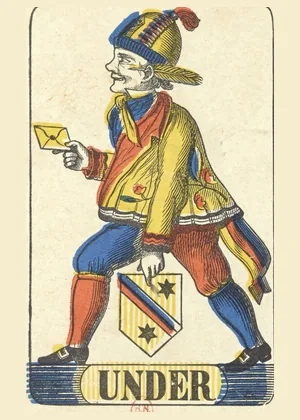
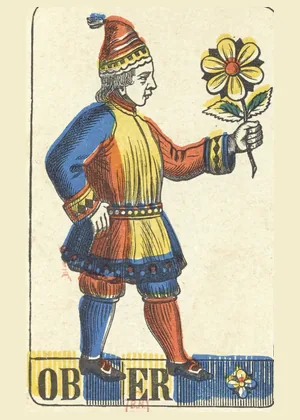
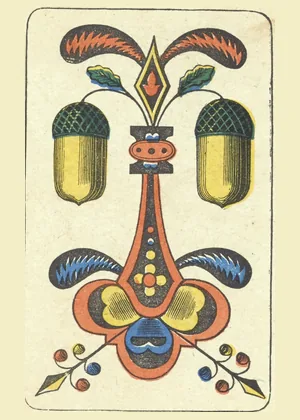
Jass is played with 36 cards, either Swiss German or French. The rules are the same with both, only the pictures differ. The Swiss German cards have the suits Eichel (acorns), Rosen (roses), Schellen (bells) and Schilten (shields), and their court cards are the König, the Ober and the Under. The French cards have clubs, hearts, spades and diamonds, with king, queen and jack. In the Swiss German deck the ten is called the Banner. In both decks the Under or jack of the trump suit becomes the Puur, and the nine of trumps is called the Nell.
Which cards lie on the table depends on where you are. The so-called Jass border does not follow the language border but runs right through German-speaking Switzerland. It follows the Brünig-Napf-Reuss line: it starts at the Brünig Pass, crosses the Napf between Lucerne and Bern and then follows the river Reuss. The folklorist Richard Weiss studied this border in the 1940s.
| Region | Usual cards |
|---|---|
| Eastern Switzerland and Zurich | Swiss German cards |
| Central Switzerland, such as Uri, Lucerne and Obwalden | Swiss German cards |
| Bern, Solothurn and both Basels | French cards |
| Valais | French cards |
| Romandie | French cards |
| Aargau | Both, split along the Reuss |
| Graubünden | Both, French more often |
How sharp this border still is today, Jassverzeichnis has worked out from tournament and order data since 2013. According to that analysis, 99 percent play with Swiss German cards in Uri, 95 percent in Lucerne and Obwalden and 91 percent in the canton of Zurich. In the canton of Bern and in Valais, on the other hand, French cards lie on 90 percent of the tables. Aargau is split almost in half. Graubünden is a special case: about 64 percent play with French cards there, less clearly than in the west, perhaps because guests from German-speaking Switzerland bring their own cards. Protestant Thurgau used to hold an island of French cards, which is less clear to see today.
Other names for the same games
In the Romandie the Schieber is usually called Chibre. The Tourne is also known there. In French the Puur is called the Bourg, and the Nell stays the Nell. The Coiffeur is played in western Switzerland too, as Jass du coiffeur, with rounds such as Misère and Slalom.
On wyys.ch you can play with the cards of your region. You choose Swiss German or French cards, and the rules stay the same. How we play the Schieber, the Coiffeur, the Differenzler and the Molotow is explained on each game’s own page.
From the table to the web and back
Online Jass does not replace the round in the pub, but it helps when the fourth player is missing or your friends live in another town. On wyys.ch you play a solo game against three bots, or you open a table and send the code to your friends. How that works is explained under Jass with friends and in the article How Jass works on wyys.ch. When you are back at a real table, the Jasstafel keeps score on your phone, or you print yourselves a slate.