Weis and Stöck in Jass: all the points and rules
A Weis earns points before the first trick is taken, and sometimes a single Weis decides the whole game. Here you’ll find out how many points each Weis is worth, which team gets to score it and how Stöck is added on top. At the end you’ll see how Coiffeur, Differenzler and Molotow handle Weis.
What a Weis is
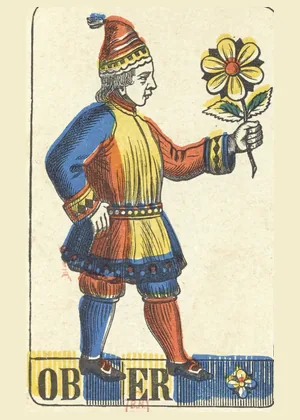
A Weis is a combination of cards you hold as soon as the cards are dealt. There are two kinds: a run of at least three cards of the same suit that follow each other directly, and four of a kind, for example four Obers or four Banners. For runs the natural order always applies: 6, 7, 8, 9, Banner, Under, Ober, King and Ace. The trump order plays no part in a Weis.
You declare a Weis with your first card of the round. If you miss that moment, you can no longer declare it. You get the points even if your team doesn’t take a single trick afterwards. Like all the other points in a round, they are multiplied by the factor of the call. So three in a row in a round of Bells ×2 is worth 40 points.
The Weis table: how many points each Weis is worth
| Weis | Cards | Points |
|---|---|---|
| Three in a row | 3 in sequence | 20 |
| Four in a row | 4 in sequence | 50 |
| Five in a row | 5 in sequence | 100 |
| Six in a row | 6 in sequence | 150 |
| Seven in a row | 7 in sequence | 200 |
| Eight in a row | 8 in sequence | 250 |
| Nine in a row | 9 in sequence | 300 |
| Four of a kind | 4 of the same rank | 100 |
| Four Nines | all four Nines | 150 |
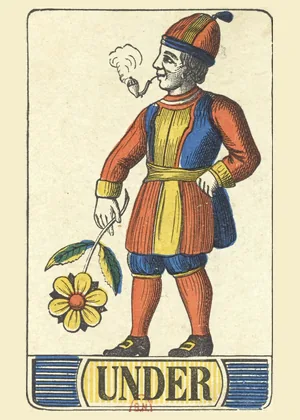
| Four Unders | all four Unders or Jacks | 200 |
On wyys.ch, four Sixes, four Sevens and four Eights also count as four of a kind, worth 100 points each, as in today’s usual table. A card can be part of a run and of four of a kind at the same time. So if you hold the Ober, King and Ace of Roses and all four Kings as well, you declare three in a row and four Kings together.
The numbers look harmless, but they carry a lot of weight. A whole round holds 157 points from tricks, and a single five in a row is already worth more than half of that. So it pays to know the table by heart and to look for runs first when you pick up your cards.
Which team scores its Weis
In Schieber only one team scores its Weis: the team with the best single Weis at the table. That team then scores all of its Weis, including the partner’s smaller ones. The other team gets nothing, even if its Weis would have added up to more. Weis are compared in this order:
- The Weis with more points wins.
- With equal points, the Weis with more cards wins. So five in a row beats four of a kind, although both count 100 points.
- If the number of cards is equal too, the higher card decides. In Undenufe the lower card is the higher one, so there the run that starts further down wins.
- If everything is still equal, a run in the trump suit wins.
- If it’s still a tie, the Weis declared first wins, counting from the player to the dealer’s right.
Only the team that wins the comparison shows its Weis cards. The other team’s cards stay hidden. That’s a good reason to declare a Weis even when it’s small: if you lose the comparison, the opponents learn nothing about your cards.
If both teams reach the target score in the same round, the points are counted in a fixed order: Stöck first, then Weis, and only then the tricks. So it is always clear who got to the target first. A big Weis can therefore end a game before the opponents catch up with their tricks.
Stöck: King and Ober of trump
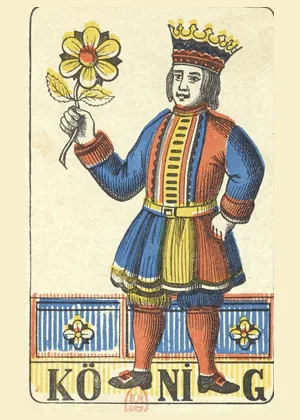
If you hold the King and Ober of the trump suit in the same hand, the Stöck is yours. It is worth 20 points and is multiplied by the factor too. Unlike a Weis, Stöck always counts. It makes no difference whether the opponents have the higher Weis or take a Match. Stöck exists only when there is a trump, so there is none in Obenabe and Undenufe.
At the table you announce Stöck when you play the second of the two cards. On wyys.ch you don’t have to think about it: the game scores it automatically as soon as the second card is on the table, and shows it at your seat.
How you declare a Weis on wyys.ch
The game recognises every Weis in your hand by itself. During the first trick a list of your Weis appears above your cards, each with its name and its points, for example ‘Three in a row, Roses up to the King’. At the start all of them are selected, because in most cases you want to declare everything. But you can deselect individual Weis or skip declaring altogether with ‘No Weis’. Your choice takes effect as soon as you play your first card.
After the comparison you see which team scores its Weis and which cards it shows. The bots declare by the same rules as you. If you’d rather play without Weis or without Stöck, the host switches them off in the rules when opening the table. A full overview of Schieber is on the rules page and in the article on the Schieber rules.
Weis in Coiffeur, Differenzler and Molotow
Not every game has Weis. In Coiffeur there is neither Weis nor Stöck on wyys.ch. Only the trick points count there, multiplied by the factor of the row played. In Differenzler there is no Weis either, and no Stöck. Everyone there is supposed to take exactly the points they predicted, and a Weis would only throw that calculation off.
In Molotow, on the other hand, Weis matters a lot, because it works the other way round there. Everyone plays for themselves and wants to take as few points as possible. So Molotow distinguishes two kinds of Weis:
- The Handweis is the Weis you declare with your first card as usual. It is credited to you as minus points, and in Molotow that’s good for you. By default nothing is compared, and everyone scores all of their Weis. The table can be set so that the Weis are compared the way they are in Schieber, though. Then only the player with the highest Weis scores, and they score all of their Weis.
- The Tischweis only comes about during play. If three cards of one suit in a row or four of a kind end up in one trick, the player who takes the trick gets that Weis as plus points. In Molotow that’s bad, since you want few points. If the King and Ober of trump land in the same trick, they give the player who takes it 20 plus points in the same way.
- If a player still holds both the King and Ober of trump when trump is set, Stöck brings them 20 minus points.
The values come from the same table as in Schieber. Because Molotow scores every round in tens, rounded, three in a row counts for less there than a big Tischweis collected at the wrong moment. You can read more about this game in the article on the Molotow rules.
Three tips for declaring Weis
- Look for runs first when you pick up your cards. Four in a row is easy to miss when the cards aren’t sorted. On wyys.ch they are, and the game finds every Weis for you.
- Declare small Weis too. If you lose the comparison, your cards stay hidden. If your partner wins it, your small Weis is added to theirs.
- Remember what the opponents show. A declared four in a row gives away four cards, and those cards will come onto the table later in the round.